Technology

To view more information click on tabs below.

Inspired by Nature

Since the discovery of bacteria, conventional thinking has led people to kill microorganisms to control them. Yet, overuse and abuse of antibiotics, disinfectants and other kill strategies have contributed to the creation of superbugs such as MRSA and others commonly found in hospitals and the general community. As biocidal approaches have made bacteria stronger, new strategies are needed to manage bacterial growth while contributing to an overall healthy environment to protect people. Such a solution may be found in Sharklet™.

Sharklet is a simple solution for a complex problem. The patented, microscopic pattern manufactured by Sharklet Technologies creates a surface upon which bacteria do not like to grow. The Sharklet pattern is manufactured onto adhesive-backed skins that may be applied to high-touch areas to reduce the transfer of bacteria among people. Sharklet Technologies is also developing Sharklet-patterned medical devices including a Sharklet Urinary Catheter to help reduce hospital-acquired infections.

A Shark Tale

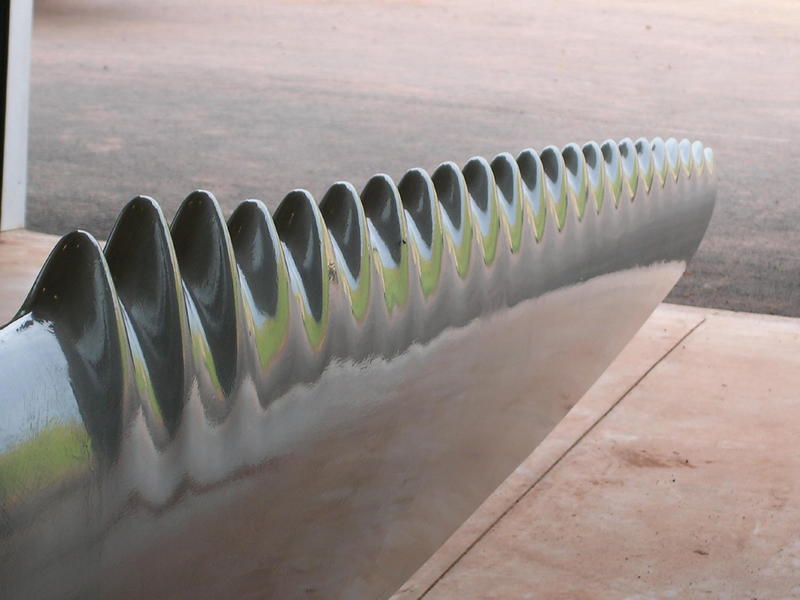
While the Sharklet pattern holds great promise to improve the way humans co-exist with microorganisms, the pattern was developed far outside of a laboratory. In fact, Sharklet was discovered via a seemingly unrelated problem: how to keep algae from coating the hulls of submarines and ships. In 2002, Dr. Anthony Brennan, a materials science and engineering professor at the University of Florida, was visiting the U.S. naval base at Pearl Harbor in Oahu as part of Navy-sponsored research. The U.S. Office of Naval Research solicited Dr. Brennan to find new antifouling strategies to reduce use of toxic antifouling paints and trim costs associated with dry dock and drag.

Dr. Brennan was convinced that using an engineered topography could be a key to new antifouling technologies. Clarity struck as he and several colleagues watched an algae-coated nuclear submarine return to port. Dr. Brennan remarked that the submarine looked like a whale lumbering into the harbor. In turn, he asked which slow moving marine animals don’t foul. The only one? The shark.

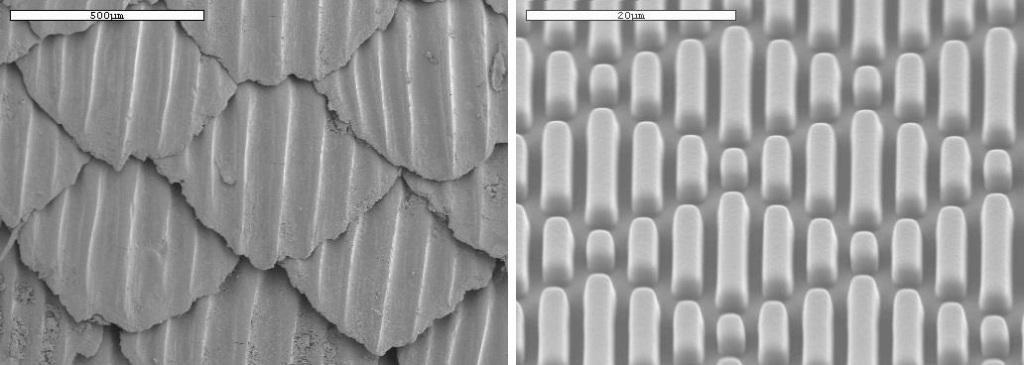
Dr. Brennan was inspired to take an actual impression of shark skin, or more specifically, its dermal denticles. Examining the impression with scanning electron microscopy, Dr. Brennan confirmed his theory. Shark skin denticles are arranged in a distinct diamond pattern with tiny riblets. Dr. Brennan measured the ribs’ width-to-height ratios which corresponded to his mathematical model for roughness – one that would discourage microorganisms from settling. The first test of Sharklet yielded impressive results. Sharklet reduced green algae settlement by 85 percent compared to smooth surfaces.

Beyond the Water

While the U.S. Office of Naval Research continued to fund Dr. Brennan’s work for antifouling strategies, new applications for the pattern emerged. Brennan evaluated Sharklet’s ability to inhibit the growth of other microorganisms. Sharklet proved to be a mighty defense against bacteria.

Similar to algae, bacteria take root singly or in small groups with the intent to establish large colonies, or biofilms.

Similar to other organisms, bacteria seek the path of least energy resistance. Research results suggest that Sharklet keeps biofilms from forming because the pattern requires too much energy for bacteria to colonize. The consequence is that organisms find another place to grow or simply die from inability to signal to other bacteria.

Dr. Brennan’s and Sharklet Technologies’ research has demonstrated Sharklet’s success in inhibiting the growth of Staph a., Pseudomonas aeruginosa, VRE, E. coli, MRSA and other bacteria that cause illness and even death.

Sharklet Technologies is proud to produce products with the Sharklet pattern to help make the world a healthier, environmentally safer and better place. We’re equally honored to offer a biomimetic technology inspired by the shark which will allow humans and microorganisms to coexist in a sustainable and healthy way.

Research & Results

Sharklet™ is the world’s first technology to inhibit bacterial growth through physical surface modification alone. The surface topography is made of millions of microscopic diamonds that disrupt the ability for bacteria to aggregate, colonize, and develop into biofilms. In bringing Sharklet to market, the pattern has been tested against many gram negative and gram positive strains of bacteria, including clinical isolates, in different media and flow conditions. Bacteria tests include Staphylococcus aureus, Staphylococcus epidermidis,MRSA, Pseudomonas aeruginosa, Escherichia coli and VRE. Sharklet tests have been conducted in Sharklet laboratories, independent facilities and United States government agency facilities.

Read the journal reports and review the data demonstrating Sharklet’s effectiveness versus a smooth surface.

Sharklet Technologies, Inc. presents testing results of Sharklet vs. smooth surfaces

View Now

Sharklet Technologies presents test results from Sharklet Technologies and independent laboratories. Findings demonstrate Sharklet performance in inhibiting growth of Staphylococcus aureus, Escherichia coli, MRSA, Pseudomonas aeruginosa and Vancomycin-Resistant Enterococcus faecalis. For more detailed information about Sharklet testing, research and performance, contact us.

Engineered antifouling microtopographies – correlating wettability with cell attachment,

View Now

Biofouling 2006

First study presenting the theory and experimental data for the interrelationship between topography, wettability, and bioadhesion. Examined the impact of engineered topographies on two biological systems, Ulva algal zoospores and porcine cardiovascular endothelial cells. The Sharklet topography outperformed all other topographies for inhibiting algal zoospore settlement.

Engineered antifouling microtopographies – effect of feature size, geometry, and roughness on settlement of zoospores of the green alga Ulva,

View Now

Biofouling 2007

A study that investigated the effect of feature geometry and size for inhibition of microorganism settlement (Ulva algal zoospore), which showed the Sharklet micro-pattern outperformed other micro-patterns compared to the smooth surface. This is explained by an engineered roughness index (ERI), a model that predicts biological response to micro-patterns.

Species specific engineered antifouling topographies: correlations between the settlement of algal zoospores and barnacle cyprids,

View Now

Biofouling 2007

A study that investigated the effect of aspect ratio (feature height) of topographical features on microorganism settlement. The Sharklet topography was again demonstrated to outperform all control surfaces for inhibiting settlement of the Ulva algal zoospore, and a barnacle-specific Sharklet topography was introduced as the best-performing topography for inhibiting barnacle cyprid settlement.

Impact of engineered surface microtopography on biofilm formation of Staphylococcus aureus,

View Now

Biointerphases 2007

First study evaluating the effect of the Sharklet topography on bacterial colonization relevant to medical devices. During the course of 21 days in growth media, the Sharklet topography significantly inhibited the development of S. aureus biofilm compared to the unpatterned control surfaces.

Engineered nanoforce gradients for inhibition of settlement (attachment) of swimming algal spores,

View Now

Langmuir 2008

A study on the effect of mechanical force gradients, which is a calculation of the difference between bending moments of two adjacent features; this concept is important in capturing the surface energy effects that may favor or inhibit the settlement of marine organisms. When two adjacent features have different bending moments, cells are subjected to different stress values on either side, creating a possibly difficult environment for settlement. In order to test the concept, a finite element mesh model was used to design micro-patterns with paired features of differing geometries (and different bending moment values); the Sharklet design consists of four different features, thus with three different bending moments. The Sharklet pattern had the lowest microorganism settlement of all surfaces tested.

Systematic variation of microtopography, surface chemistry and elastic modulus and the state dependent effect on endothelial cell alignment,

View Now

Journal of Biomedical Materials Research Part A 2008

Systematic evaluation of how variations in elastic modulus, surface chemistry, and height/spacing of micro-ridges interact and effect endothelial cell attachment density, viability and alignment.

Potential for Tunable Static and Dynamic Contact Angle Anisotropy on Gradient Microscale Patterned Topographies,

View Now

Langmuir 2009

Investigation of static and dynamic contact angle anisotropies on various engineered microtopographies (including Sharklet) to evaluate the effect of discontinuities along the feature length on the anisotropies previously reported for channels/ridges. Introduces the potential for designing micropatterned surfaces for directing fluid motion (e.g., self-cleaning, microfluidics).

About Bacteria

The world of microorganisms is a dynamic one and all forms of life depend on microbial metabolic activity. In fact, there are more microbes living on and in every human being than there are cells in our bodies. At the most basic level, there are microorganisms that are harmless or offer beneficial functions to living things such as aiding in digestion. Other microorganisms keep detrimental microbes at bay. However, there are some destructive microorganisms, such as the kind that attack living cells or create toxins that can cause illness and death. Since these two types of microorganism often live side-by-side, it has been a significant challenge, specifically within the healthcare community, to control the growth of the destructive organisms while promoting the growth of the beneficial.

As healthcare providers have fought to protect patients from harmful microbes, they have, over time, unwittingly given rise to superbugs. Consider that MRSA infections in emergency rooms have increased 211 percent between 2000 and 2008. The January 2010 issue of Microbiology states that the improper and overuse of disinfectants in hospitals has contributed to the bacterial resistance epidemic. In our quest to control bacteria with toxic chemicals, antibiotics and cleaners – we haven’t defeated bacteria but only made them stronger.

New strategies are needed to inhibit bacteria without further contribution to the problem of antimicrobial resistance. Sharklet™ presents such a solution. Sharklet is the world’s first technology to reduce bacteria growth through pattern alone. Sharklet doesn’t kill bacteria to control it. The patented microscopic features of Sharklet simply create an unstable surface on which bacteria don’t like to grow.